Sunday, 23 March 2014

Volcano Sockeye – Oct 7, 2010 - Updated, Mar 23, 2014

Volcano Sockeye – Oct 7, 2010

A volcano blows and Fraser sockeye come back in record numbers. Is there a connection? There could well be. Roberta Hamme, at UVic, and colleagues have just had a new paper out in the Geophysical Research Letters that studies the issue. In 2008, volcano, Kasatochi, in the Alaskan Aleutian Islands blew its top and ash drifted out over a large area of the North Pacific Ocean.

Within a few days the largest bloom of phytoplankton ever observed spread across more than 1000 km of surface water. The connection with sockeye is that they eat plankton. Their food is stimulated by the addition of iron, in this case from the volcanic ash, and plankton begin fixing carbon dioxide from the air and growing and doubling in rapid order.

Of great interest is that the iron only stays in the top layer of water for a few weeks before it starts settling out lower, and plankton levels begin falling. At this stage it is not known whether iron can once again be lifted by strong Aleutian winds blowing the surface water aside, resulting in upwelling, or whether deep currents can carry the vital metal to other areas. But the plumes of plankton photographed from space are convincing. Compared with 2007, when Fraser sockeye were very low in numbers and plankton levels were visibly very low, the 2008 satellite shots show a massive bloom of sockeye food.

And fortunate for the fish and everything else that depends on Fraser sockeye, the ash came in summer. This period is when sockeye put on their greatest weight – high sunlight also increases plankton numbers. DFO managers tend to look at population numbers resulting from spawning and predict outcomes. But the ocean’s ability to support salmon plays a great role in keeping fish alive and fattening them up. In the past, it was thought that most of the fattening was done in near coast waters, in the later years – so an open ocean bloom should not have much effect.

Tim Parsons, at the Institute of Ocean Sciences in Patricia Bay, thinks there is another explanation. 2009 numbers barely exceeded 1 million sockeye, whereas we all know the 2010 numbers were an almost unheard of 34 million. This, of course, is confusing, particularly to the Cohen Commission, currently hard at work trying to figure out the cause of the crash. And, the various, environmental, scientific, fishing and farming interests try to use the change to support the views they hold.

As Parson pointed out in a note to me, the main question is: if the bloom occurred in 2008, why did the next year’s run collapse while the following summer, 2010, produced a huge return? Good question. Here’s his answer: animals generally have lowest growth rates at the beginning and end of their lives. In between, like all teenagers, sockeye eating and growing peak. More survive, too.

The sockeye returning in 2010 would have been in the midpoint of their lives and the most dynamic part of their growth curve. The diatom and crustacean peak occurred at the same time and they ate such food as the main source of their diets. Later in life, though, and this prevailed for the previous 2009 returning sockeye, their peak growth period came before the volcano let fly. Since there was no volcanic iron to spark a plankton cycle, the 2009 sockeye had been eating the smaller, less prevalent zooplankton – means animal-based – that prevailed before the ash. Hence they were not supported well in their time on the open ocean.

So what does this mean? Well, if there is no volcanic explosion there will not be as large a plankton bloom. This implies that next year’s Fraser run may well be smaller than the just-past summer. As the volcano only explodes every now and then, it cannot be counted on to buoy sockeye numbers on an on-going basis. On the other hand, if the iron can be brought back up from the depths as part of the normal upwelling process, the effect may last longer. And, of course, iron is only one piece of the puzzle.


690 Words   


Wednesday, 19 March 2014

The Life of Lings


Two weeks ago, I caught a 12-pound, hatchery, white chinook 500 yards west of Trial Island on the ebb at 115 feet in 130 feet of water (perhaps a three-year old Harrison, or Nooksack/Samish fish, as we don’t mark many). This is just west of the rock close to Trial. Surprisingly, it took a Purple Haze hootchy with a gold Mylar skirt. Typically, here, if we use a skirt at all, it would be silver; however, gold is the Nootka Sound standard and the hootchy I picked was so rigged.

Also surprising: I was towing anchovy on a wire-rigged, glow-pearl, 602 bait head behind a glow green Farr-better flasher which is my standard winter rig and the one I expected to take the salmon. It received a chomp or two, but that’s all. It was the hootchy caught the salmon, and three ling cod and one black bass. It occurred to me the ‘bait’ on my depthsounder was a bass school, something I have not witnessed for many years in these waters.

Lingcod have an interesting life cycle. Females lay eggs from December to May in shallow water, even intertidal, in a mass up to 30 pounds – beyond 36” all lings are female, and should be released. The male guards the eggs and fans them. After they hatch and nurse for a few months, they migrate out of shallow water by July. In a year, ling are 10.5 inches; by two about 18.5. Males become sexually active in another year, but females require several more, producing 100,000 eggs, and as they grow up to 500,000. Note the ling limit is 65 cm (25.5”) – when they are open for retention. Check regs before fishing.

The three ling I took the first day were 14 inches, just shy of two years. The next week, using the same gear, I had difficulty getting around Trial as although the tide was ebbing, the current was still flooding. When I finally got west of Trial, the back eddy was not yet set up properly. But in that spot, and back on the Flats, every bump yielded a ling, five in all (14- to 16-inches), and also two rock fish. The latter were sad, swim bladders protruding from their mouths and simply bait for seagull or eagle. But that was 8 two-year ling, indicating they migrate to deeper water after this period.

About 10 years ago, I and others from the Sport Fish Advisory Board sat down and drew up the Rockfish Conservation Areas from Sooke to Saanich Inlet. I laid out Trial Island as I have often fly fished for them just off the kelp in the rocks, and caught and released many. Coming forward to today, I’d say these protected areas must be working, given all the unintentionally intercepted ling and rock cod.

A friend, Lance Foreman, told me he was in a school of fish leaving the surface, off the Ogden Point Breakwater, and wondered what they were. I am guessing they were not herring going up the Gorge, as he would have identified them. The alternative, and I have seen schools of several hundred while walking the breakwater, is black bass. Another clue that, although these are mid-water fish, they are often found near kelp and rocks, so the RCAs must be working. I’d like to hear from other anglers whether they have noticed the same increased numbers of such species in the greater Victoria Area.

One final note: Lance is a Clover Point angler, the guys who have car-toppers in the shed there. He took a 35 pound halibut off the Quarantine Buoy in more than 300 feet of water last week. There were some superb tide days for halibut. After catching nothing near Trial, he putted on out, putting down a spreader bar (short arm takes the weight) with herring and some salmon for a tougher bait.

Sunday, 9 March 2014

Banner Salmon Year 2014 - March 9, 2014

Expect big salmon numbers this summer. The Fraser sockeye run may be as high as 70 million. Yes, 70. And the most important sport angling species, chinook and coho, seem to be on the same meteoric route in 2014.

Fraser sockeye numbers peaked in the early 1970s and then declined, most particularly in the 20 year period from 1990 to 2009. This was the year the Cohen Commission was sent in to figure out why only 1.6 million sockeye returned to the Fraser, and just as it was getting rolling, 2010 returned more than 28.3 million Fraser sockeye.

While DFO has significant issues (including almost completely ignoring the Cohen Report), it has to be admitted it does a stellar job of sockeye science, and I have the approved pre-season estimate of the more than 100 subcomponent sockeye run from early May into late September for anyone who wants to immerse themselves in this science heavy process. [PDF] They have patchy data back to 1913, with better stats from the ‘50s to the present day. DFO uses four different models and puts out estimates based on five different levels of possible return from 10% to 90%. The 2014 range is: 7.2 million to 72.0 million, with an average of 22.8 million, with expectations at the high end.

Then DFO follows fry down rivers, for example, the Chilko counting fence, passing Mission and a seine fishery in the Strait of Georgia, with acoustic arrays in Queen Charlotte Sound as well as Juan de Fuca. On the way back, test gillnetting is typically done in Port Renfrew as well as Johnstone St. Fish are counted crossing the Mission fence, and samples from all fisheries are sent for real-time DNA testing twice per week, with announcements on run timing, composition and fishing opportunities for commercial, sport and first nations coming every few days as summer progresses. Impressive.

Why are the fish in good numbers? Good question. The 2010 high year contributes mostly to the run this year as sockeye are typically four year old fish on returning. It looks like the taking of fish farms producing chinook out of the water in the Discovery Islands (near Campbell River) in 2008 that were getting salmon leukemia virus (SLV) is one main reason – do note DFO followed this disease for years until they terminated research.

Doctors Kristi Miller and Brian Riddell will be ramping up her science lab, that you will remember showed a ‘viral signature’ disease that contributed to as high as 90% pre-spawn mortality in returning Fraser sockeye. But the 2010 fish were not infected, and thus returned and successfully spawned, resulting in, we hope, prodigious numbers, in 2014. In addition, fish farms reduced their own fish numbers, particularly Marine Harvest, in 2011 to 2013 by 30% or 6- to 9-million smolts in the narrow Quadra Island to Sayward salt waters. So there were trillions fewer viral particles when the fry migrated.

You will be happy to know that Miller/Riddell will be testing a lot of fish this year, including those from fish farms. But you won’t be so happy to know that DFO, and the fish farms will be parsing news releases – if you followed the convoluted, non-transparent, fish farm refusal to allow BC disease-testing results to come out during the Cohen Commission, you will understand why.

Of note, is one subcomponent that has done well – the Harrison. Its long term average escapement, i.e. sockeye on the spawning beds is 13,500, but both 2010 and 2011 returns were 30 times higher than the long term average at 400,000. The Harrisons are the only subcomponent that migrates out Juan de Fuca Strait where there are no fish farms. They could not get sick, so they returned in healthy numbers. The rest of the Fraser sockeye migrate through Johnstone Strait.

But there is more to this story than fish farms. That is because – other than the Fraser 4-2s that DFO, in the Salmon Outlook, said further 2014 non-retention would be likely – around Vancouver Island, the fish return numbers of coho and chinook will be records, too.

First, the sockeye story. The largest run is the Alberni Inlet, Henderson, Nahmint, and Somass (Stamp and Sproat) rivers which typically returns 350,000 to 600,000 fish, with a high of 1.8 million. Sport and commercial fishing begins when it is established 200,000 fish are coming down the Inlet. I have seen years the run has not struggled up to this level.

As with all runs, there are always some younger, sexually precocious male fish, called Jacks. In the past, as three-year fish, the Alberni run had an average of 40,000; however, last year, there were, get this, 400,000 mixed in with the run. That implies a 2014 run ten times larger than the average, perhaps 4 million this year.

While the fry do pass a couple of fish farms on the way out, the huge number of Jacks implies that ocean survival has been terrific. Perhaps the Alaska volcano that blew in 2008 showering the Bering Sea with iron oxide heavy dust was the reason, but the more likely event is the winter storms we now call Pineapple Expresses contribute to the Aleutian low-pressure cycle. The wind pushes surface waters aside, bringing nutrients to the sun-penetrating level, starting huge plankton blooms that feed the food chain. Sockeye eat plankton and krill. And surface temperatures were cooler than normal - a good thing.

Higher marine survival typically means more three year old Jacks. As chinook, these return as roughly 15 pound fish. The West Coast Van Isle hatcheries at Conuma in Nootka Sound and the Nitinat in Juan de Fuca returned Jacks up to 50% of their runs – this was common among other counted rivers. I can tell you from fishing the Nitinat in late November – nursing five fractured ribs, which kept me from fishing earlier – I landed four Jacks one day, some six weeks after the run had spawned and gone. Some years I catch zero in the entire season, even though these fish will beat all other fish to whack a lure.

There are no fish farms on either of these routes. And then there are the Cowichan chinook. As 1- to 2-year fish, they circle Georgia Strait before migrating out to the open ocean. Last year 7,000 returned – this run was down to the unheard of level of 1,068 spawners circa 2010, with, previously, a run average of 12,000 to 15,000 chinook with a high of 25,000. Last year 4,000 of the returnees were 3-year old springs! This points to a return in 2014 of higher numbers than the highest ever recorded. Van Isle chinook typically return 90% at four year old fish, which implies 40,000 chinook for the Cowichan alone in 2014.

And then there are coho. Last year WCVI wild coho returned in the Salmon Outlook’s highest measured category - 4. And those Georgia Strait coho, that crashed in the mid-80s, with 1- to 2-% return measured against parental spawners, are forecast at 15% - that means 15 fish for every fish that spawned in 2011, rather than 1. Many of these fish migrate passed fish farms in the choked waters of Johnstone Strait. As farm numbers were down 30%, and ocean survival high, these two factors may explain the inside high coho numbers in 2014.

But it doesn’t explain high coho numbers on the WCVI. And they are expected to continue in high numbers in 2014. They don’t pass fish farms, hence, the return is based on higher marine survival.

There is great potential for inside coho fishing, now and in years to come. Brian Riddell, CEO, Pacific Salmon Foundation, is emphasizing rehabilitation projects to increase Georgia coho. He has estimated such a fishery could be worth $400- to $500-million additional sport fishing revenue, added to the $1 billion sport fishing creates in BC annually. Time to fish.

dcreid@catchsalmonbc.com

1300 Words


Tuesday, 4 March 2014

Fraser 4-2 Chinook and Summer 2014 Victoria Fishing


DFO’s current chinook regulations are: March 1 to June 13, 2014, in Victoria areas 19 and 20, the daily limit is 2 chinook which may be wild or hatchery marked, between 45- and 67-cm or hatchery marked greater than 67 cm. The subareas are: 19-1 to 19-4 and 20-5, and correspond to waters from Cadboro Point to Sheringham Point.

Do take part in the Sport Fish Advisory Board talks, and the person to whom you can address questions about management measures to protect and conserve Fraser 4-2s, is Brad Beaith, on the Island, at: 1-250-756-7190 – not in Ottawa. 
 
The summer regs have not yet been developed, but you can expect, given the ongoing Fraser Spring 4-2 low numbers that retention opportunities will reflect that. The document of concern is DFO’s Southern BC Salmon Integrated Fishery Management Plan (IFMP). Here is a summary document: http://www.pac.dfo-mpo.gc.ca/fm-gp/mplans/2013/smon/smon-sc-cs-2013-sm-eng.pdf.
From this document, the entire sport sector, as represented in the Survey of Recreational Fishing in Canada, which is done every five years by DFO, shows that in 2010, total expenditures for tidal sport fishing were: $689.7 million by BC residents, non-resident Canadians and non-Canadian non-residents.

The freshwater fishery typically adds another $500 million, so total fishing expenditures in 2010 exceeded a billion dollars, at $1.19 Billion, as it usually does. While the data collection and massaging methods differ, in comparison, the BC Stats figures for all of aquaculture, calculates a very small GPP contribution of $61.9 Million, showing fish farms should be taken out of the water, something the Province can do in 60 days by cancelling leases.

In addition, Pacific Salmon Foundation CEO, Brian Riddell, whose great interest is bringing back St. of Georgia coho, has suggested that would add an additional $400- to $500-million to the saltwater sport stats. So getting fish farms out of the water is a no-brainer – but DFO is in Ottawa.

I should add that DFO did lots of science on farmed chinook in the Discovery Islands near Campbell River, through the 1990s, showing, with much work done by Michael Kent on salmon leukemia virus (SLV), the farms, which were on the out-migration route of Fraser chinook smolts. These were removed circa 2008, and Fraser sockeye/chinook, generally rebounded.

But not the 4-2s. These are followed by coded wire tagged Nicola River (turn right off the Coquihalla onto the 5A near Merritt, for a stellarly beautiful drive through rolling grass hills and solitary pines to the east side of Kamloops) chinook released from the Spius Creek hatchery which are the exploitation indicator stock (the Cowichan is another for a coastal ‘stream’) for CDN/USA fisheries.

Based on CWT recoveries, Fraser 4-2s have largely been encountered in Fraser First Nation net fisheries, Fraser River and tributary sport fisheries, marine troll fisheries (e.g. WCVI and North Coast), and recreational fisheries in the Strait of Juan de Fuca and Strait of Georgia, with lower rates in other marine sport fisheries.

Returns of 2013 spring 4-2s came primarily from a parent generation of only 844 spawners in 2009. This is an exceptionally low number of fish to base a fishery upon, hence our retention problems in Victoria, in the early summer.

Spring 4-2s return early March to late July. Migration peaks in June in the lower Fraser. These populations primarily mature at age-4 (90%) with lower numbers at age-5 (7%) and occasionally at age-3 (3%). Once they are past Victoria, we get improved opportunities, with as well all know, Harrison River white, and some Vedder River chinook.

They are now often the largest fish – the Columbians used to be our early, biggest fish – of our summer, with Harrison’s typically topping the Island Outfitters Leader Board in September from the Owen Point ledge to Camper Creek run in Port Renfrew, often plus 40-pound fish. Also, these are taken in September on late afternoon rising tides at Creyke and Aldridge points in the bay between Beechy Head and the Bedfords. If you timed your fishing correctly, some of these big fish would be slipping from Folger to King Edward, to the Cape Beale apron, just in time to fish Bamfield in the Port Alberni Labour Day Derby.

June one year, a young lad took a 50 pound chinook from the Turkey Head at Oak Bay Marina, and staggered in to the shop to stagger everyone there. I would bet it was a falling tide and the fish stopped on the east side waiting for the push. And the trench in McNeill, as well as Ten Mile Point would also be good on the ebb. In McNeill, do note there are tide and current changes, and that the latter spill this way and that by Trial Island, meaning get there two hours before the low to ensure your big one is still trapped in the gulch.

Here is the IFMP for 2013 – 2014 (the 2014 – 2015 plan comes out in June): http://www.pac.dfo-mpo.gc.ca/fm-gp/mplans/2013/smon/smon-sc-cs-2013-eng.pdf. This document shows that DFO does a terrific job at research in this 226 page document (there is a North Coast plan, too), that I heartily recommend you taking an hour’s cruise through. We all know the issue is habitat restoration and enhancement, things that DFO is remiss at – that could have solved the 4-2 problem a decade ago – rather than doing a wonderful job at documenting their demise.


Sunday, 23 February 2014

Wire-rigging a Teaserhead - Feb 23, 2014


I am often asked to rerun my column on wire-rigging teaserheads for saltwater salmon trolling with bait, typically anchovy. You might want to save this, or remember it will be on www.onfishingdcreid.blogspot.com.

Wire rigging is standard practice in the CRD area. You can fish a teaser out of the box with the treble hook inserted high behind the dorsal fin, but wire rigging helps maintain bait spiral longer and more consistently. We commonly use the O’Ki Juan de Fuca (JDF) heads and the Rhys Davis teaserheads.

Both types hold bait in the same way unlike other types, typified by Roller Baiters from Hotspot. Crimp the eyeballs of the bait, insert it into the teaser head and use an inline pin or toothpick to hold the bait. Sit down and rig 25 at a time, starting with a single treble on six feet of 25- to 30-pound mono (not too-stiff fluorocarbon) leader, with an Octopus-style, Kirbed single three inches behind, on the tag end. Do one after the other and wrap each around a tackle box leader board, so you have enough for a year.

Next, cut stucco wire (for securing chicken wire) in 6-inch lengths (not piano, spring or stainless as they won’t hold curves). ‘Drill’ two holes in the side of the trailing wing. JDF heads cause bait to spiral because the trailing wing has a curve in it and the leader exit is above the centre mark of the head; teaserheads have a flange that sticks out on the trailing edge for spiral and the leader exit hole is off-centred on the top leading edge. (You can make both spin like bullets, if you wish, by drilling holes at the centre point).

A large, long-pointed Siwash hook drills the wire holes. These two holes are parallel to head axis either right below the JDF blister or just in front of the teaser flange, 3/16th of an inch apart, one in front of the other. Speed the ‘drill’ step by heating the Siwash point over a lighter. It will eat through plastic like butter. Or, leave three straightened hooks, points on a stove element; or large, long, heavy-duty sewing needles; a very light fid would work, too.

Make sure the holes are only wide enough to pass the wire or toothpicks – loose wire or toothpicks don’t work properly. The toothpick holes you drill on the top edge of the head behind the leader exit hole and also on the bottom. Also a pair from side to side on heads without an inline pin. Scrape extra scrim off all holes with your thumbnail.

Bend the short wire pieces with needle nose pliers. Bend 3/16th of an inch to a right angle, then 1/8th to 3/16th to a right angle. This will put make a small ‘hook’ on one end. Insert the other end into the head’s trailing hole from the outside to the inside. Pull the wire through, so the leading ‘hook’ point goes through the other hole and sticks out on the inside of the head.

The care you take in the next step is the most important to ensuring a solid rig. Squash the bit of wire that is left on the outside of the head with needle nose pliers. At the same time, bend back the trailing wire parallel from the head with your thumb nail as close to the exit hole as possible. Then, holding the head between thumb and forefinger, turn the head over, and use the pliers to first bend the ‘hook’ on the inside. Then, pressing hard on the trailing wire, take the bent leading wire end and head wing in your pliers and firmly press it right into the plastic. It should not wriggle at all.

Also use four ball bearing swivels: top end of the leader, bottom end of the flasher, top end of flasher and bottom end of main line. This enhances bait spiral and gives fail-safe bearings so the always-spiraling rig does not just simply tangle the leader and/or mainline into a fritz. As you will be fishing 20 minutes between checking bait action and condition, you could be towing a tangle the entire time.

For the hook rig, I use a brass #3 or #4 treble (actually a freshwater hook), barbs flattened, for a leading hook, with a sliding knot, followed by a 4/0 to 6/0 single, nickel (rusts out of the fish in a break off), Octopus-style hook, with a sliding knot, as the trailer, three inches below the treble. Fix a ball bearing swivel to the leader, with a Palomar knot. Add a 3-mm eye to the outside of the teaser, as it is the side the fish sees. Put a toothpick in the blister to snugly hold the leader.

If using a non-glow JDF head, say jelly-fish, use a fluorescent pin on the head as an attractant. When using a glow-head, use a red pin, which perhaps imitates a gill opening. Finally, trim the wire to the bait size on the water, remembering that no wire should stick out of the bait. Gently insert the trailing wire into one side of the gills, then back through the body until the anchovy head snugs into the teaser.

Add the top and bottom toothpicks, and from side to side in a head without an inline pin. Snap all ends flush to the teaser. Keep all toothpicks dry – and use flat ones not round ones – in a plastic pill bottle on the boat, with a hole in the top, so that you can turn it upside down and a single toothpick will drop in your palm.

Now, insert one point of the treble halfway between the lateral line and dorsal surface and halfway between the dorsal fin and tail. Now the important part: curve the bait from teaserhead, making the curve greater curve toward the tail – for that killer spiral (not a roll). Be assured your bait will fish true the entire time between letting down and bite, or other bump in the dark. The curve makes the tail follow the head within the diameter of its spiral – crucial in Victoria.

Finally, note that treble placement puts the trailing single directly behind the tail so hook is the first thing the salmon closes on – much better than the original, single-treble version. In my two-hook version, the treble has no other purpose, making it easier to get the single hook from the fish’ mouth.

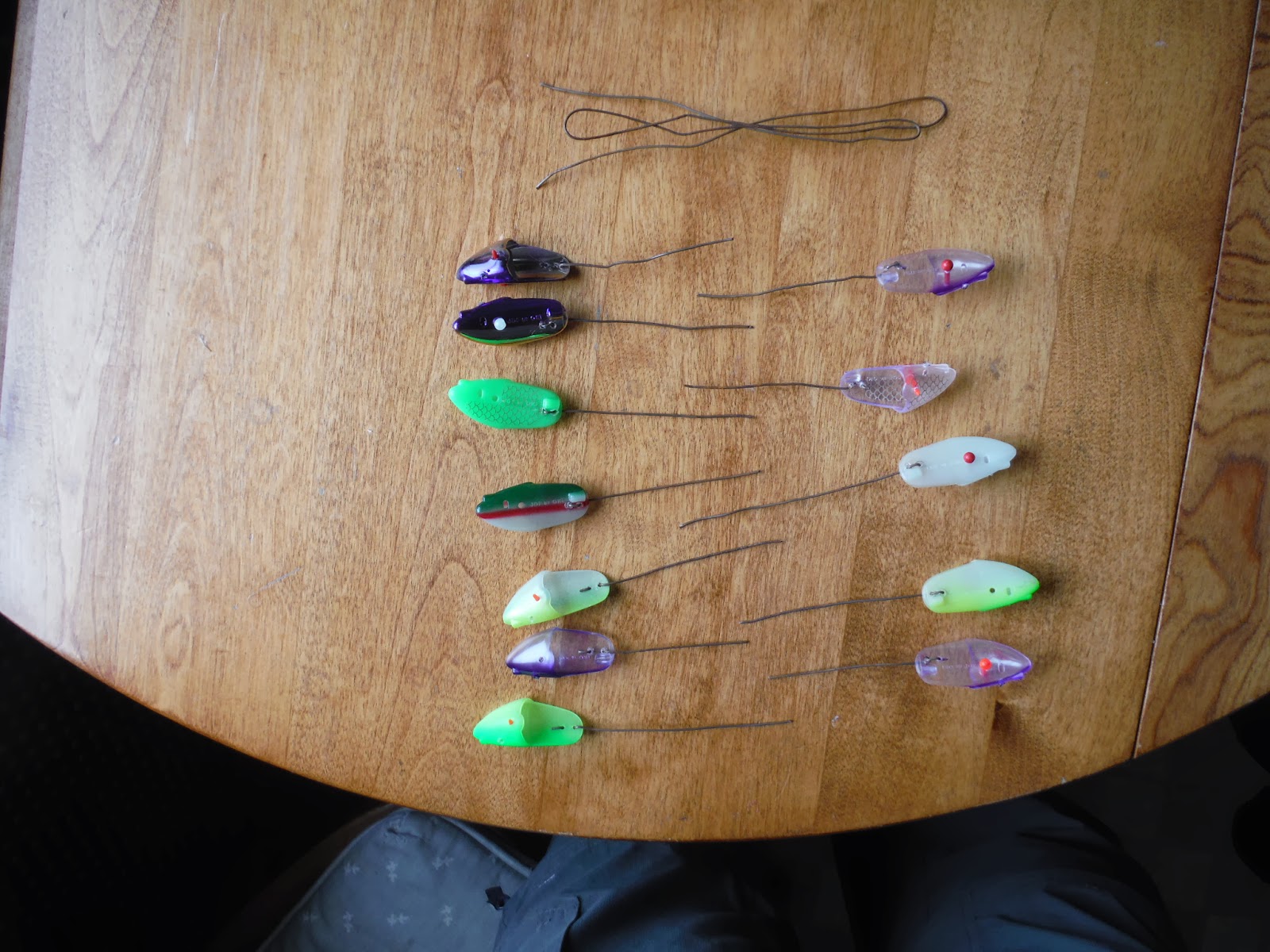
Note: I have been asked to put some photos of wire-rigged bait heads here. Two shots are below. You can zoom them in to take a look at how the wires look once inserted. I give you both the front and the back side of the rigged heads. And there is a sample of the wire that you can get where they stock stucco products. To these you add the double tandem hook rig mentioned above and finally trim the wire shorter before inserting it in the gill plate of the bait.


Questions to: dcreid@catchsalmonbc.com

Sunday, 16 February 2014

Q and As – February 2 – Feb16, 2014


Halibut: The new size limits for halibut are: 133 cm and 93 cm, the first about 70 pounds, the latter, 20. So says Brad Beaith, one of the good guys at DFO. And, to clarify, my previous mention of the Swiftsure Closure, I was simply restating the longstanding closed area that we are all familiar with, not that there is any new closed area.

And also, it needs to be said that all sport fishers know good people in DFO. Many on the coast are high on our list, particularly enhancement people. When we, and I include me, criticize DFO it is not the good people here, but the moribund department, mostly in Ottawa, that don’t get salmon in BC.

Circle Hooks: I attended the Esquimalt Anglers meeting recently, and we talked about circle hooks. These are better for bottom fishing for halibut. Once they meet the scissors of the jaw, they seldom come out and you land more flatties from their chewy bites.

But I would not fish circles trolling for salmon. The reason is: the bent-back point tip is the first thing the grab and run winter chinook bite hits, meaning the point is not naturally penetrating, and thus you lose fish.

Circle hooks meet their best use in freshwater fishing salmon, particularly chum. The schools are so large and dense a straight point simply buries in whatever flesh it hits and a day of wrestling 20, 20-pounders to the beach and removing the hook is a lot of wasted energy for fish and fisher. With  circle hooks, you feel the various bodies and fins it slides over, but days chum are ‘snappy’ you miss no biters.

Seals: Seals in winter can be so thick you lose most chinook. I have chased many, many seals to keep them underwater, hoping they will release the fish to get some air.

The Esquimalt guys passed along a tip from Scott Craven. Seals have gotten so good at separating fish from line it makes sense to, as he does: loosen the drag and put the rod back in the rod holder. The seal will separate the fish, or bite it off behind the head so quickly you will be back fishing in no time.

Done this way, you can continue using 25- to 30-lb leaders between flashers and lures, rather than going to 15-pound test; that approach leaves you the expensive part of the set up - flasher and anything above - important because it is difficult to know, if mainline breaks, where stretching may have weakened it above the missing ball-bearing swivel. The down side is you need to shorten leaders to transmit flasher kick to lure, particularly hootchies and squirts.

Lower test on leaders leads to another problem: keeping lower and higher test leaders separate in your tackle box. Instead of the usual inch of plastic drinking straw most fishers use (after wrapping-up the leader around your fingers), use twist ties for the lower number of lower test leader/lure combinations. Ties need to be replaced annually for corrosion reasons; they discolour leaders and, more importantly, plastic lures.

Habitat Restoration: Apparently, DFO added money to the original $10 Million across Canada over two years for habitat restoration, perhaps as much as $15 M.

BC Wildlife Federation says: “We are pleased that funding… has been increased and continued for another two years. These funds… support important conservation projects related to recreational fisheries habitat… undertaken by conservation organizations and community groups, including BCWF Member Clubs,” said BCWF President Bill Bosch. The point of the program is to leverage what conservation groups add to the process, a good thing.

You will note this in the DFO Program Objective: “The Recreational Fisheries Conservation Partnerships Program forms a key component of the Government of Canada’s conservation agenda as outlined in Budget 2013 and aligns with the Government’s commitment to better protect Canada’s fisheries as reflected in the recent changes to the Fisheries Act.” The problem is all BC fishers know the important changes gutted the Act (s35 and s36) of fish habitat protection measures.

These are the FAQs: http://www.dfo-mpo.gc.ca/pnw-ppe/rfcpp-ppcpr/faq-eng.html. None address the question of whether the $15 M is across Canada for two years, like the earlier amount. I have asked for clarification and will let you know.

The original announcement of $10 M across Canada is: http://www.dfo-mpo.gc.ca/media/npress-communique/2013/hq-ac52-eng.htm.

Fish Farm Sewage: my preliminary estimate of the sewage cost to BC residents of leaving fish farms in the ocean is a staggering $10.4 Billion. To ground proof the figure, I have dredged up the stats for Scotland, and Norway (where fish farms are from). They are equally staggering, and I’ll release these shortly.


dcreid@catchsalmonbc.com

Tuesday, 11 February 2014

Winter Steelhead Time


A Pineapple Express is forecast this week, so think winter steelhead. Rising water and high tide brings them into rivers like the Cowichan and Stamp. In the latter, new fish hit the Confluence Pool in three hours. Wear your raincoat and fish until water turbidity declines to less than a foot. If you have to fish high, brown rivers, remember biters may be within a foot of shore, and where clear streams enter.

Dry weather moves steelhead into pools and they become skittish in runs. In cold, ice forming in your rod guides, hit them on the nose, running dink float setups down multiple times, before moving on. The best fishing is on dropping water after rain, in straight line runs, 3 to 8 feet deep. Learn the 3-D contours of river bottoms you fish frequently.

Gear fishing, with floats and split shot, or pencil lead and leader off its swivel, gives you the best opportunity to learn run dimensions because you can raise or lower the float, changing mainline distance to the weight. Cast out sequentially, in one foot ‘strips’ and run downstream to learn the bottom.

Steelhead are found near rock more frequently than wood, like logs. In winter, they are on the bottom - rivers can be colder than the ocean, in clear weather associated with low temperatures. Fish sink to the bottom and move only inches for lure or fly. I once plumbed a run forty times before the 14 pound winter whacked the lure on the Gold River one frigid February morning.

Dropping water and knee deep visibility are the highest percentage days. Steelhead are very aggressive and will smack anything. When you catch a hatchery steelhead you will keep, always check its stomach for what it may have been eating. I got one in the Stamp that, when gutted, was stuffed with salmon eggs. I could not see the eggs tumbling by me in the water, and it was December, past all spawning but a few remaining chum, with coho more likely in side-stem streams. But the steelhead was selectively picking up eggs and had nothing else in its stomach.

Little wonder gear guys prefer eggs when regulations allow. I once spotted a steelhead finning in its spot, and put a glob of eggs behind a spoon. It looked more like a golf ball than roe-bag. I cast across and above the fish. As the lure swung into view, the steelhead picked up the scent and began moving forward. From behind and out of sight, as much as 25 feet, a 10 pound coho rocketed from invisibility, passed the steelhead and smacked the roe. So I got to keep a fresh coho.

The point is: salmon eggs leave scent passing downstream. It is a huge stimulant and worth pursuing a very long way. I suspect the smell is a pheromone, and more particularly, to fish about to spawn; hence the coho beat the steelhead to the roe as the latter needed several months of ripening.

One more thing: add different rivers to your repertoire in winter. One example would be the Nimpkish on the north Island. You will have to stay overnight as it takes me four hours from Victoria to hit Sayward Junction, where the Fisherboy Hotel is good value for two, one half hour short of Woss, with the Nimpkish just beyond. There are six to eight miles of highway accessible river before it moves away and drops into its canyon shy of the Zebellos turn off.

Plan a north island trip with a half dozen rivers in mind. The Campbell, itself, is worth a plumb as its summer steelhead run has split into two, with January being a high month now. For fly guys, January can also be good for large cutthroat. Explore the Quinsam from the Campground near the logging bridge at Haig-Brown’s Sandy Pool. Consult your fishing friends for info, or join the local fishing club – there are many on Vancouver Island – they can save a decade of prospecting on your own.


dcreid@catchsalmonbc.com