Sunday, 26 August 2018

Sockeye Tracking and Fishing


One part of DFO’s science activities is monitoring Fraser River sockeye sub-components in salt- and fresh-water. It makes estimates based on brood years and then authorizes fisheries with in-season test seine and gillnet fisheries in Johnstone and Juan de Fuca straits, as well as in-river. As below, you can request to be put on the list, which runs all season long, twice per week.

Here is the beginning of the Friday August 25, 2018 Panel review:

Gill net test fishery catches in the Fraser River have increased the last 2
days with daily catches being around 180 for Cottonwood and 170 for Whonnock.
Daily Mission escapement estimates have declined from 164,200 on August 20 to
70,700 on August 22 followed by an increase to 125,500 on August 23. The
estimated total Sockeye escapement past Mission to August 23 is 3,072,100. This is
comprised of 121,400 Early Stuarts, 1,002,000 Early Summers, 1,646,800 Summers and
301,900 Late run fish. Stock identification analyses from recent samples taken in
the lower Fraser River indicate that Early Summers are making up from 11% to 15%
of the stock composition while Summers make up about 80% and Lates are ranging
between 6 and 11%. Within the Early Summer run group, the later timed South Thompson
Early Summer stocks continue to be the dominant stock with very low levels of Nadina
continuing to be present. The Summer Run run timing group are primarily
Chilko/Quesnel with lower proportions of Late Stuart/Stellako and Raft/North
Thompson. The current estimate for holding Late Run fish is approximately 770,000.

While most sockeye have passed through our area, with the exception of Harrisons, here is how to
fish for them:

In the sixties, it was figured out that a red Krippled K and a red Gibbs flasher would take sockeye and thus the sport fishery got off the ground. Both sport and commercial troll fishers used the same tactics: slow, straight and short. In other words, sport guys would troll as slow as possible, tossing out a pail on a line to slow the boat down below its normal trolling speed.

Short referred to leaders, in the 23- to 25-inch length. Straight meant to troll in straight lines. The other characteristics of sockeye is that they are good followers, as in, once locked on a lure, they will follow it for some time, before committing to a bite or moving on. Further, they like flash.

Over time, the rig that developed paid attention to the following/flash behaviour. Put down three flashers on each downrigger. The upper and lower ones, with five to ten feet of 25-pound test to a release clip, do not have lures and are simply there to draw in the sockeye to the flash. The middle flasher typically trailed an orange squirt or a tin spoon. In addition, scent was put on this lure. So once following, the rig kept the fish there until they spotted the lure and whacked it.
 
See this Butch McPherson site for a history of ‘Krippled’ products: http://www.krippled.ca/recreation/about.htm. 
 
In the nineties, things evolved further. We found that instead of being in the top 50 feet, coho, began returning as deep as 125 feet in Juan de Fuca Strait. Surprisingly, sockeye seemed to migrate with them, so also deeper. In addition, in the odd years, the Fraser pink salmon could be spread down the water column just as deep.

And, good for us anglers, the presence of up to 3 species, and a growing USA coho load, had the effect that all the fish competed with one another for lures. I would guess that more fish with the same amount of feed lead to the competition.

Another useful feature became apparent. I noticed one day fishing Sooke, while deep in my forward compartment, that when I popped my head back up, I was almost on the rocks and cranked a hard 90-degree turn. In that instant, I received a bite and shortly landed a nice sockeye.

Another thing also came clear. One could increase trolling speed because one target was coho which like a faster lure, and pinks are opportunistic. The coho part also meant for increasing leader length to as much as 35 inches, and fishing tide lines, particularly their leading edge (as in where the bait were coming from, to then be sandwiched in the tide line). This also has the advantage of covering more territory in the same amount of time, and so presenting before more fish in shorter time.

Every now and then crank a 90-degree turn, and darned if you didn’t get a sockeye that may have been following for some time. So, straight, slow and short became, not so straight, faster and longer.

Contact DFO with questions and request to be put on their list for receiving the Sockeye Panel emails  that go on all summer long: DFO.OpsCentreFisheryPacific-CentreOpsPechePacifique.MPO@canada.ca

Sunday, 19 August 2018

North Van Isle Pink Salmon Flies – 2018


The flies that took pink salmon in the estuaries this summer included ones coloured pink, blue, green, purple and combinations of these colours. Purple handle bar flies were good, followed by pink handle bar flies, however, handle bar flies, which are usually sparse, in other colours were also used.

Here is a shot of my small box for pink salmon on beaches/in estuaries:
 
It features my take on a Fuzzy Pink with irregular, long tails, among other flies. The variety of other flies are there to try when the fish won’t take anything, and I’m searching for answers. Some years a pink Muddler is the answer, but not this year.

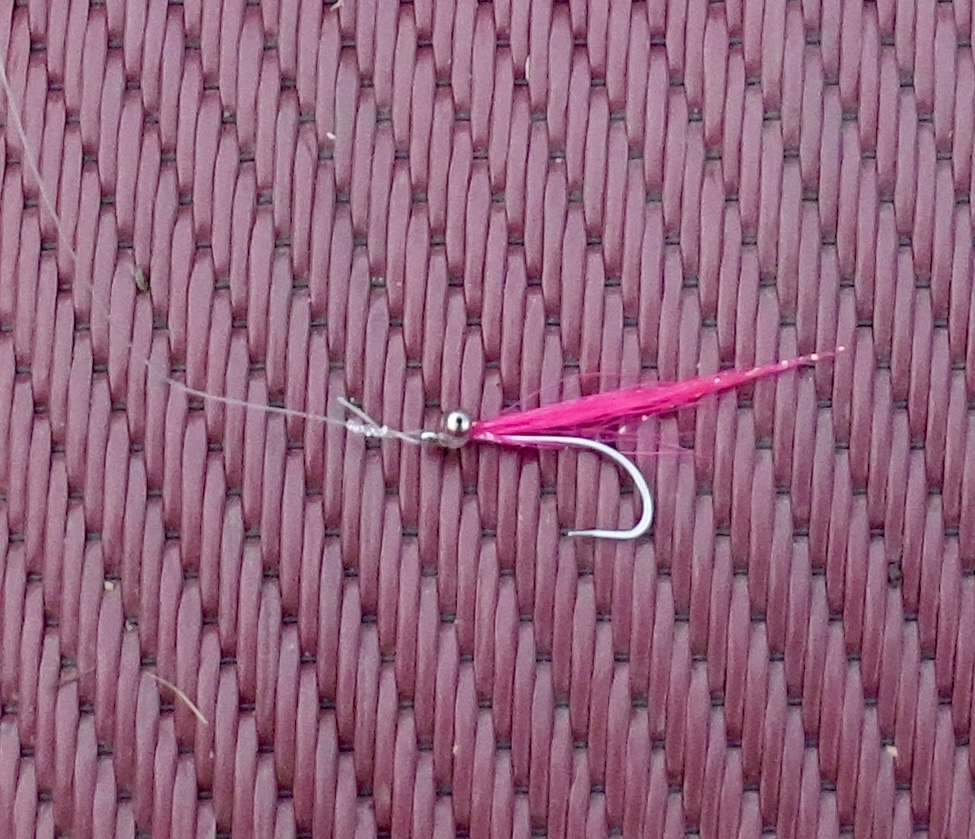
Next is several flies close up. The top fly is Jerry’s fly. Note that it is a small streamer, with a silver body, and blue/green/yellow strands on top, as well as an epoxy eye. This fly caught many fish this year. It looks a little less blue than when I first tied it on.


If you blow the shot up a bit, you will find that Jerry’s fly has an Improved Clinch knot that has been pulled away from the hook eye and then tightened down on itself. I use a high quality, thin diameter, 15 lb test leader, and the pull-back is needed to give the fly more natural action. I don’t like losing fish to lighter test leader, and hence accept that the higher pound leader may make a leader-shy fish refuse to bite. In my opinion, this seldom happens. The diameter of this Snowbee leader is thinner than most 10 lb test leader material. So why sacrifice fish to snap-off.

The second fly is a Fuzzy Pink. Note the long, scraggy tail. I think it gives the fish something larger to aim at and thus bite more frequently. If I am not catching fish, or getting bites but no secure hook-ups, or someone is getting more bites on a ‘shorter’ fly, I snip off some of the tail and try again.

The bottom fly has no name. It got so many bites that the pink bead eye, mylar, chartreuse thread and Krystal Flash kept slipping round the bend of the hook, until I took the fly off, opting to coat it with Hard as Hull once I got home, and try again in 2019.

The bottom two flies use a pink mylar tube product that comes in rolls in shops that sell saltwater trolling gear. It is used to slip around the hooks of coho spoons as an added attractant. It makes for a simple fly and does not cause the angst from slicing a slice of pink plastic sheet and winding it around the shank, tying off at both ends. This process leads to flies unraveling and is why I switched. 

Purists will say that the winding process imitates segmentation. I think what matters is whether the fish bite the fly being used and have caught hundreds of pink salmon on this fly over the years, even though it was neither the best fly nor colour in 2018.

The best colour was a fly that had some purple in it. I was sold on Ken’s fly, an epoxy minnow with purple strands in the back, until I lost the two he allowed me to filch from his fly box. Having said purple, some purple flies did not work. I tried a purple Muddler and it received nary a tap and went back into the box for another year.


The final contender was Vince’s fly. As simple as it is, it was a killer the morning we were out on the bar alone. The first day I was not in the zone, but changed to an intermediate sink, 32-foot head, with running line that followed the head down. Then I was in the zone with his simple, but effective fly.


Sunday, 22 July 2018

Hunting Salmon


It is time to take your 6-weight fly rod and fish the beaches for salmon. The closest place to Victoria to catch pinks is Cherry Point – after crossing the Malahat driving north, turn right off the highway at the Rona lumber/hardware store and make your way down to the beach.

And there are dozens of beaches that have pink salmon on them all the way up Vancouver Island. Well known fisheries include Nile Creek, Oyster River, Campbell River, Eve River, Cluxewe River and the Quatse River. But there are many more volunteer projects and the end of July is high season for the earliest salmon returnees. (Sockeye are usually the first, but there are few on Van Isle’s east coast). The north end of the Island is an even year run predominant area, thus 2018 should be a peak year.

If you are lucky, and there aren’t too many fly fishers beside you, you can get in on the highest quality fishery, where you hunt the fish, ones that you can see. The variables are tide, wind, waves and current. Also add angle of the sun relative to where you are standing.

The best beach for this is the Cluxewe. To the north side of the bermed opening of the river – a choke point is always fishy because it bunches the fish together, rather than them being spread out – the beach is dead flat for hundreds of yards north, as well as to the east. This gives you the opportunity to spot fish touching the surface, track them down, and place a fly in front of them. Surprisingly, while salmonids easily spot what is above water, they seldom spook from seeing your legs and feet under the water.

It goes without saying that you should use your highest percentage fly, either from past use and your log books, or what is your best fly on the day you are fishing. Typically, pink salmon flies are pink, but blue, green and more recently purple should be in your fly box. If someone else is catching more fish than you, sidle up and ask to see the fly, or at least, ask what the colour is. Also buy some of the generic ones at River Sportsman in Campbell River as you pass through, as they work, having had the kinks worked out by proving them in the Campbell. Note that their well-trimmed pink Muddlers, size 8 can be good, as well as in blue, for Dolly Varden.

On calm days, do remember that you should have a leader of at least 10 feet. That is because if you have ever stripped in a fly that is less than six feet from the line, the fly line is obvious in clear water on a calm day. In fact, hope for some wind that ruffles the surface, so the fish drop their guard and are more bity. The rejoinder to what I have just said is: the longer your leader, the less likely the fly will be at the same depth as the fly line. Keep both in mind. And thirdly, the higher the current, the shorter leader you can get away with because the fly moves past the fishes eyes so quickly it must make an immediate decision, and thus does not see the fly line behind.

The higher the wind, and this is an every day occurrence on Johnstone Strait, the higher the waves. This means that you will be jumping straight up every wave that comes at you. Make sure to time them right so you don’t take a wader’s full of cold and wet. Or get pulled off the edge into deeper water.

On the right days, with the sun behind or beside you, you may witness one of the wonders of the animal world. Pinks coming on shore, have a tendency to jag onto their sides then straighten out every few seconds. What this looks like is flashes of silver, as though cameras are flashing all over the place in the water in front of you. These are turned on fish, and you are going to catch some provided you do several things.

Your fly line, with or without a sink tip, must be in the zone, meaning at eye level to the fish, presenting your fly at the same depth. If you are not catching fish, change your set up. I carry a second reel so I have both full float and sink tip, along with two pouches of the many slime line and other sink tips I have acquired over the years.

In the tide department, hunting fish is usually more successful on a rising tide. That means the fish will be stimulated, and moving by you, into the estuary. If you can inspect the spot on a lower tide, do so, and get to know where the pinks stage before following the tide into the river. Station yourself between where they stage and where they must go.

If you find, say, a hump of land that has edges that drop off to the deep, you have good structure to work with. The fish will hang on the edge thus you will have a naturally occurring structure that bunches the fish together. (The alternative is where wind, wave, tide and current create a seam or tide line, that is also structure, even though it is just water, and fish will mosey up beside the quickest water, or stop on either side). When the fish begin to move in, and you are in less than waist deep water, when you see the flashes, plant your fly up-current of the fish and count it down, trying to see your fly line as it descends to time being in the zone. 

One tip here: you can get more sink out of your line, by throwing extra line into the cast after the line has settled on the surface. This looks sloppy to another fly fisher, one who does not know that doing what it takes to catch fish is more important than casting to look pretty. Your line and fly will present lower in the water column, and if you hook a fish, keep on throwing in extra line after each cast. This means the fly has been floating longer without being under connection to the rod tip, so it is technically, drag ‘free’ and thus drops, rather than a swung fly, under connection and thus higher in the water column.

What you do is make the same distance cast every time and then throw in 3- to 6-feet extra. Then on the next cast account for that extra, by reeling it in at the end of the cast, or holding it over a finger, so you are always making the same distance cast, and throwing in the same amount of extra, hence, the fly is always presenting at the same spot, just shallower or deeper. You can plumb the water beside your intended target, by casting a shorter cast, or a longer one, and also throw in the same extra.

Current has two components: tide and river output. When a river flows out into the ocean, a rising tide will make higher waves where the two meet. This is even more pronounced on a windy day. Timing your jumps becomes very important, particularly when fish have been staging where the rising tide is coming from. Having that natural structure of a bar in front of you accentuates the same phenomenon, giving you fish bunched closer together than where there is no edge of structure.

The Cluxewe beach bottom substrate is so flat there is no edge, other than the river berms, and so the fish can be spread out across the bay until they move right to the mouth. So, keep an eye open for fish action on the surface, for several hundred yards around you. The slightest action, in the context of wind, waves and current, is a shiver on the water, caused by fish right under the surface, but not breaking it. That is the most common pink indicator, while jumping, porpoising, dorsal fins breaking the surface, and on occasion, jaws and eyes of pink salmon, are less common behaviour. And remember the old saying: jumpers are not biters, they just show you where the fish are.

Being in the zone usually refers to a person who is catching fish. On many beaches, one or two will be catching more than others. Pay attention to what these people are doing, and along with their fly, figure out what kind of fly line they are using, leader length, and the position they have placed themselves with respect to the tide, 3-D structure of the beach and the natural migration path of the incoming fish. You will learn something, and then repeat what you have learned. For example, the next day, at the same level of tide put yourself in the spot before it happens and then do what you can to be in the zone that the person did the previous day.

Sunday, 15 July 2018

The Joys of Boating


The other day, sun climbing from Mount Baker, I drove through sleepy Oak Bay Village before 6 AM. The day before, I had started the boat, and listened to its purr of money, got the downriggers out, rigged the rods with flashers, bait holders and spoons, so that I would be ready to go when I cast off the lines. On my fishing day, I rigged one line with a large anchovy in a 602 teaser, behind a Farr Better Flasher in green. The bait had been moved from freezer to fridge the night before, so it would be unfrozen enough to insert the wire, and bend it behind the dorsal fin, before inserting the treble hook.

Heading out from Oak Bay Marina through the gap at the Turkey Head, I throttled up. The bow rose above my eyes and stayed there. I gave it more gas, but it would not settle, so I tried the other obvious thing: I tilted the leg down, and as it descended the boat came up and settled flat at cruising speed. Ah, the joy of a boat that treats you well, when you treat it well with regular infusions of cash.

The tide was ebbing, and following my own advice, prior to fishing the Flats, where fish had been brought in in the past few days, and other boats were already fishing, I turned the corner to fish an ebb tide back eddy, until 9 AM, when the flood would begin, and I would join my confreres on the Flats.

My own advice is that in summer fishing, when big springs are relentlessly heading east at 1.5 MPH close to shore in shallow water, it is best to fish the ebb tide back eddies where they will fin forward, but stay put, until the tide turned and flood push them east, toward their natal river. By the time I had the slow spiral on the bait, that I use in summer for large fish, rather than the slightly faster spiral for winter fish, the boat had been carried to the west end of the eddy.

I swung the boat around, heading east, into the ebb. After ten minutes, it dawned on me the ebb was strong enough that the boat was not gaining any ground. The GPS speed-over-ground feature registered zero to half a knot. Mighty slow. Several Grady White and Trophy-style boats motored past me en route to the Flats. I was happy to see them go as it meant they would not be fishing in the restricted area that comprised my back eddy.

Another ten minutes went by and it was clear I was going nowhere. I hit the green button for the ball, disconnected the release clip, and throttled up. At six knots, the boat soon putted up to the head of the eddy, whereupon I sent the ball, release clip and bait down to 33 feet. Then the boat made a loud beep, beep, which is what it does when the key reaches the first détente prior to starting. But I was not starting the boat, and the beep, beep continued blasting in my ear. 

Several minutes of this rattling odd behaviour ensued until it dawned on me that the ongoing beep must also be an engine warning sound. Oil pressure was fine, the temperature was not over heating, and the fuel tanks registered lots of gas. At which point, I hurriedly got the ball back up threw the rod and gear into a glumph before the transom and throttled up.

I gave it lots of gas, but no matter how much I gave the engine it would not speed the boat beyond 7 knots, nor reach the plane. Then a tremendous backfire almost deadened my hearing, followed almost immediately by another in-board engine backfire bigger than the first. 

It was time to make for the marina and hope the engine was going to make it back from Trial Island. I had been here before. One summer, more than a decade ago, I was fishing pinks four miles south of Trial, in a well-developed tide line. My main engine began over heating on the temperature gauge, and smoke began pouring from under the engine cover. I throttled up onto the plane and behind me left a cloud of smoke, flames coming out and beginning to melt the gas line to the kicker.

At this point, I killed the main engine, and started the kicker. I had to sit on top of the engine cover smoke making me disappear into purple haze, hand wrapped in a towel, to hold the hot tiller. As the minutes went by, the boat stopped burning, my rear end began to cool, and my heart came back to near normal. I waved at a boat going by, they waved back and kept going, not understanding I was in trouble.

But, I thought, I’ll just putt my way home. Several other boats went by, waving at my growing frantic wave, but not stopping to help. The kicker kept putting. After two hours, the light beginning to move well into the western sky, Trial Island was still some miles away, and the ebb tide was carrying me away to the west. Wind began to rise from the north east, bringing waves up to four feet. I was going nowhere, and was not going to reach safe harbour, going like this.

I had to make the difficult decision that I had no choice but to restart the main engine and hope it did not overheat until I reached safely. Soon, up on the plane, things began to look a little happier. It was with relief that I passed the south tip of Trial. Then through a seven-foot standing wave, that sent everything in the cabin flying. The boat landed so hard, I thought the hull would break.

The engine began its skyward climb into the danger zone. Soon it was higher than the boiling point of water, and heading for 250 degrees, as I passed the golf course corner at full blast. On shore, golfers leaned on their drivers and one pointed at me. The reason was that I was leaving a blue cloud of smoke. I passed the Oak Bay Beach Hotel at rocket speed, and full bore made it through the Turkey Head gap, with flames coming out the back end. At way over reasonable speed, I made fast for my slip, hoping the boat would not explode before I had it tied off, and could grab the fire extinguisher.

To my great good fortune, another boater on the dock, seeing the long line of flames from my engine, raced to my slip, and grabbed the bow line, while I hit reverse. The engine died, the flames grew higher and I exited right over a gas tank that could explode, extinguisher in my hand. From the dock, I aimed the CO2, fearing the engine was going to blow apart, taking me with it. The other boater handed me a hose, and I doused the back end with water, enough to fill the engine compartment and separate flame from gas tank. 

All of this other near-death experience raced through my mind as, just the other day, my boat slowly, achingly made the golf course corner tee box, backfiring so loud, I closed the door between us. I opened the forward hatch and prepared to jump and pull the toggle on my life jacket. There was no way I was going to kill the engine. The anchor and line were in the forward compartment, minutes away. The kicker may not be able to beat the ebb home. 

The backfires grew louder, the boat speed slowed to five knots, and I shot the Gap, too fast for the tethered boats beside me. If I didn’t slow down, I would hammer the boats on B dock and hit my finger fast enough to lift the bow right out of the water. I had no choice but to back off on the gas. 

To my great relief, as speed slipped down to 2.3 knots, the engine came clear and clean, as though nothing had happened. I turned past the kicker of my neighbour, hit reverse, then hit neutral and grabbed the stern line and slid it over the cleat. Thank god. Oh, to be on the dock separated from an engine that might blow. 

I went straight for Gartside Marine services, just by the parking lot, and, fortunately, Kelly, their office person, was already in working, and drew up a work order, before I left, shaking, to my car. Ah, the joys of boating. The last time it was a completely new engine, that was $13,000 at the time, in 2003. No doubt a new engine is far above that price today. Will my insurance cover the problem? We’ll see.